The fundamental difference
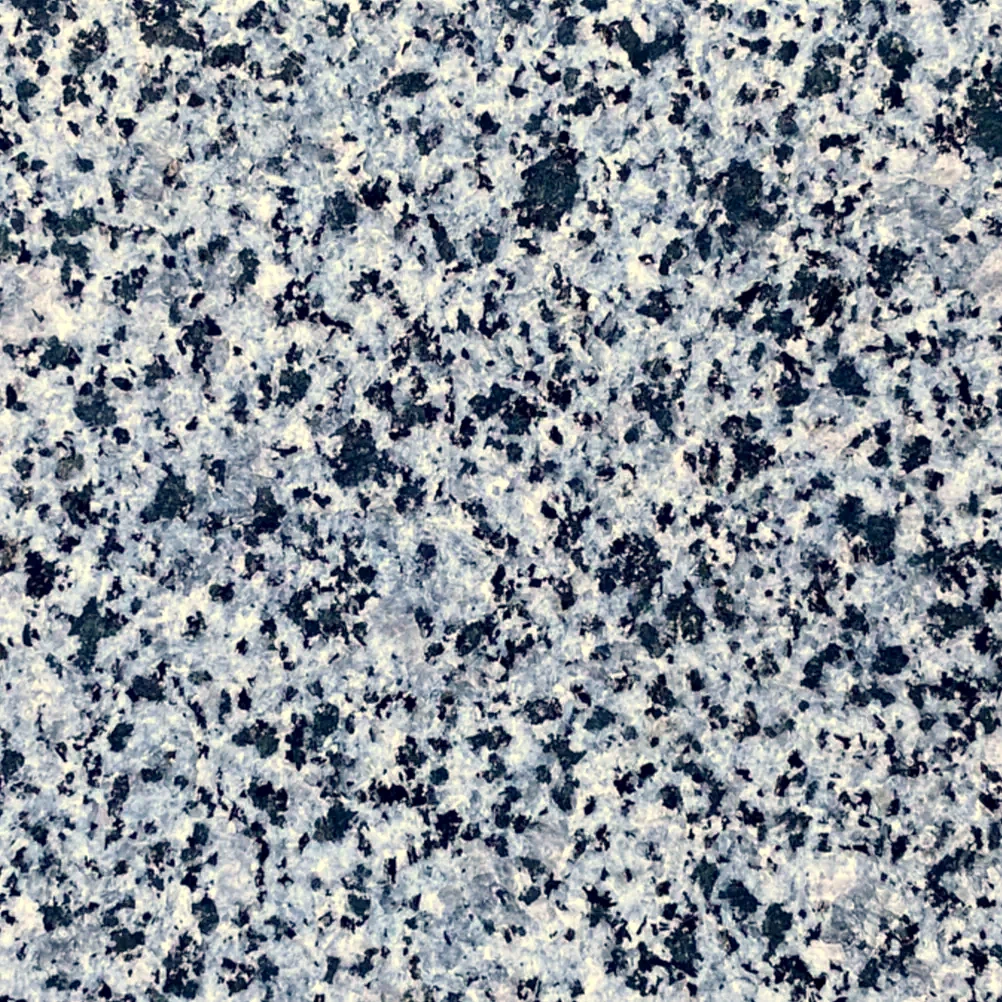
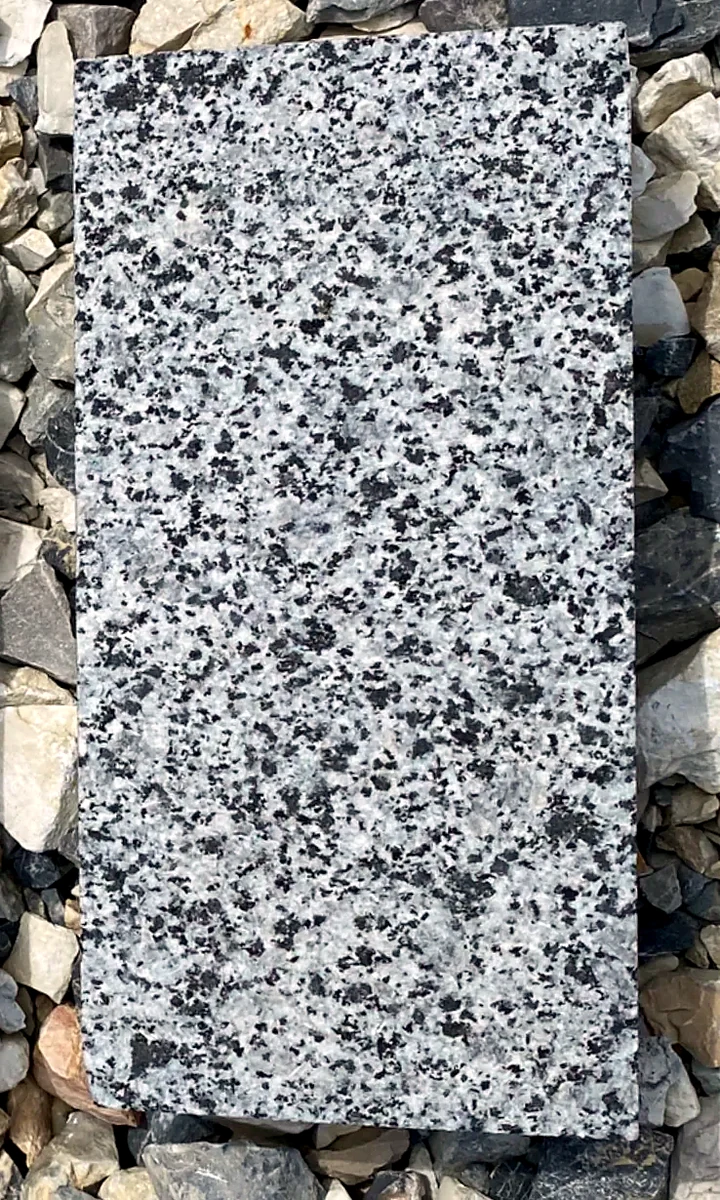
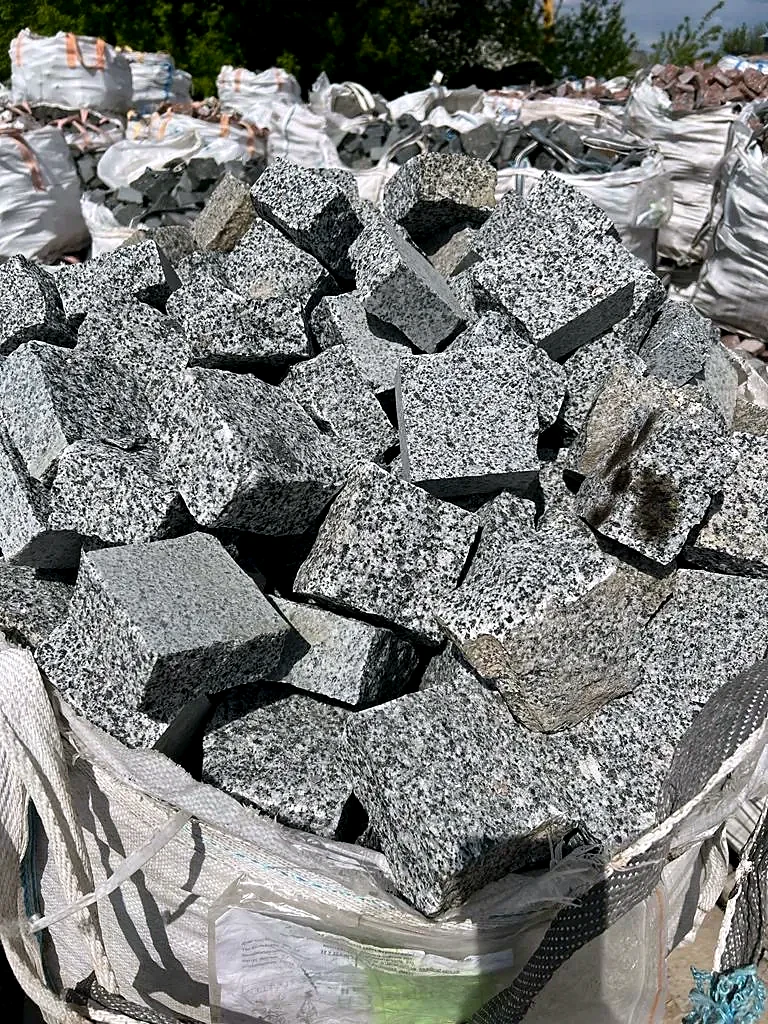
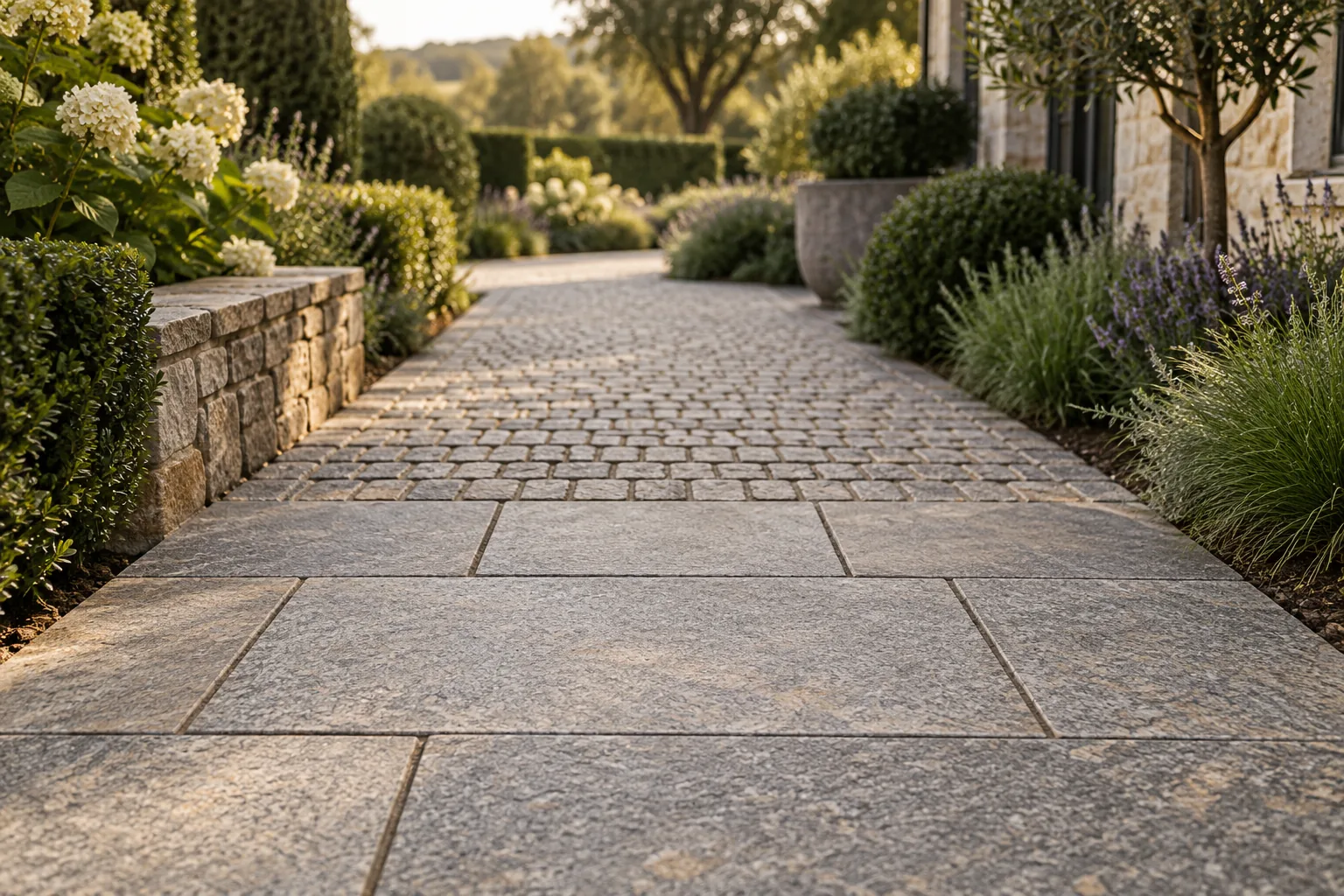
Paving slabs are relatively large format units. They create a regular visual grid and reduce the number of joints. Granite paving uses smaller split, sawn, sawn-and-split or tumbled units. A small module makes it easier to work around covers, trees, radii and irregular boundaries.
Format does not define the top-face finish. A slab can be sawn with a flamed top, while a sett can be split, sawn or combined. Specify the walking-face finish separately, particularly for entrances, terraces and areas exposed to water or ice.
| Criterion | Paving slabs | Granite setts |
|---|---|---|
| Visual scale | broad, calm planes | a finer rhythmic grid |
| Number of joints | fewer | more |
| Irregular boundaries | require accurate cutting | easier to follow with small units |
| Local repair | a larger unit must be lifted | usually a small group of setts is replaced |
| Support | uniform support beneath the slab is critical | load is distributed through many units |
| Layout | rectangular, modular, large-format | linear, curved or mixed |
Where slabs are often appropriate
Slabs work well on terraces, entrance landings, broad pedestrian routes and contemporary public spaces. A large format reinforces architectural geometry. Where the site includes many corners, columns or curved edges, prepare a detailed cutting layout before ordering.
Specify slab support for the selected installation system. Avoid unintended voids or unplanned support points. Engineered pedestal or point-supported systems must be assessed against their documentation; this article neither prohibits them nor establishes that an arbitrary slab is suitable. The base construction, thickness and permissible loading are set by the designer or responsible contractor; there is no universal slab thickness for every terrace or driveway.
Where setts are more practical
Split setts suit paths, courtyards, parks and settings where a pronounced natural texture is desired. Sawn paving gives more precise geometry and a more consistent joint line. On an irregular site, a small unit can reduce the number of large offcuts.
Setts are also useful where underground services may be repaired later: units can be lifted and returned after the base has been reinstated. That does not remove the need for design — gradient, drainage, edge restraint and supporting layers still matter.
Pedestrians and small wheels
For wheelchair users, walking aids, pushchairs and luggage, assess the completed surface rather than the stone alone. Joint width, level changes, installation accuracy and texture all matter. Large even slabs can simplify movement, but a poorly installed slab creates a significant step. Small paving has more joints, while precise sawn geometry can make them more predictable.
For entrances and pedestrian routes, inspect a sample wet as well as dry. “Flamed” describes a processing method, not a universal promise against slipping. If the project specifies performance values, request evidence for the exact stone and finish.
Combining slabs and setts
The two formats can work together: slabs for main landings, setts for frames, paths or curved sections. Agree thicknesses, finished levels, joint widths and transitions before ordering. Granite kerbs can restrain the edge, but their cross-section and installation also belong in the specification.
Natural stone colour varies between batches. Where different formats of one material are combined, approve slab and sett samples together rather than at different times from screen images.
Information needed for a quotation
- A site plan with dimensions, radii and obstacles.
- The use of each area: pedestrian, terrace, entrance or vehicle traffic.
- Stone selection and preferred finish.
- Proposed slab or sett formats.
- Kerbs, steps, covers and drainage locations.
- Delivery address and receiving conditions.
Cutting allowance follows the layout. The same percentage is not appropriate for both a rectangular terrace and an irregular site with curves. Send the plan through the quotation form to compare alternatives on the same basis.
Frequently asked questions
Which costs less, slabs or setts?
It cannot be compared without an equal specification. Stone, format, thickness, finish, cutting, packing, transport and installation all affect the result.
Can slabs be used for vehicle access?
They may be suitable when format, thickness, support and base construction are designed for the actual loading. Format alone is not enough.
Can an individual slab or sett be replaced?
Yes, if the element remains accessible and spare stone from the same batch is available. A later batch may differ in shade.
See also the comparison of split, sawn and sawn-and-split paving and the guide to outdoor finishes.
Sources and scope — checked 14 October 2026
- NIKA GRAN paving slabs — product range, materials and stated finishes.
- NIKA GRAN paving catalogue — available product types.
- Granite Setts UK: finishes — processing terminology; that supplier's values are not claims about NIKA GRAN products.
This guide supports format selection and briefing; it is not a structural pavement design.