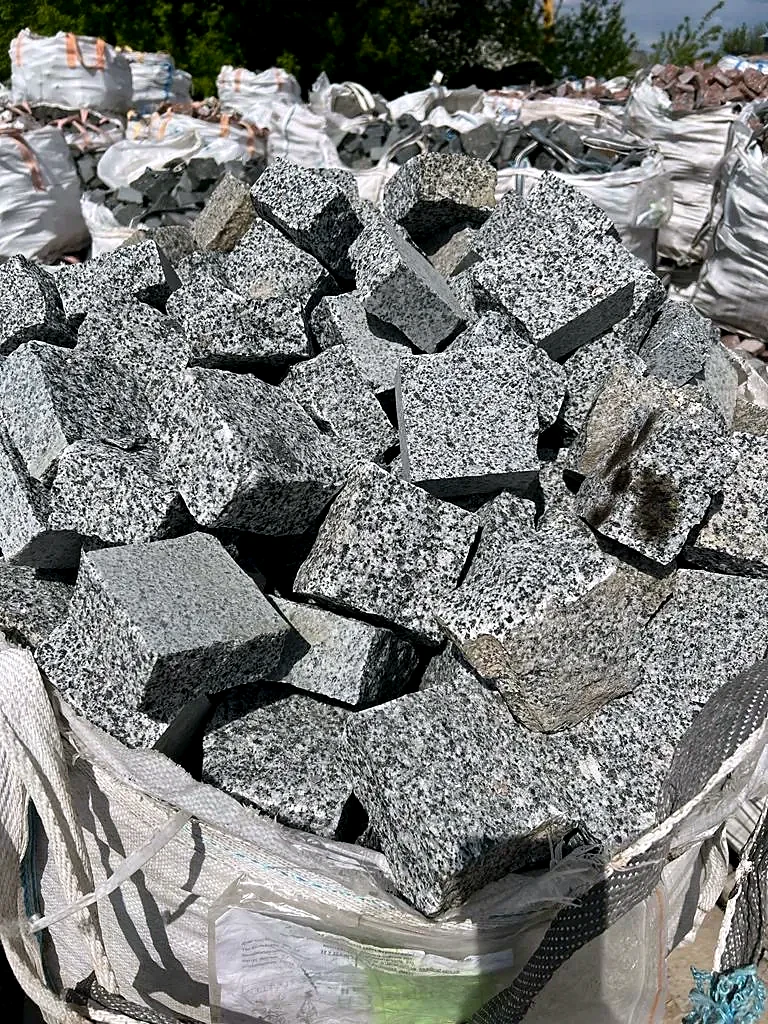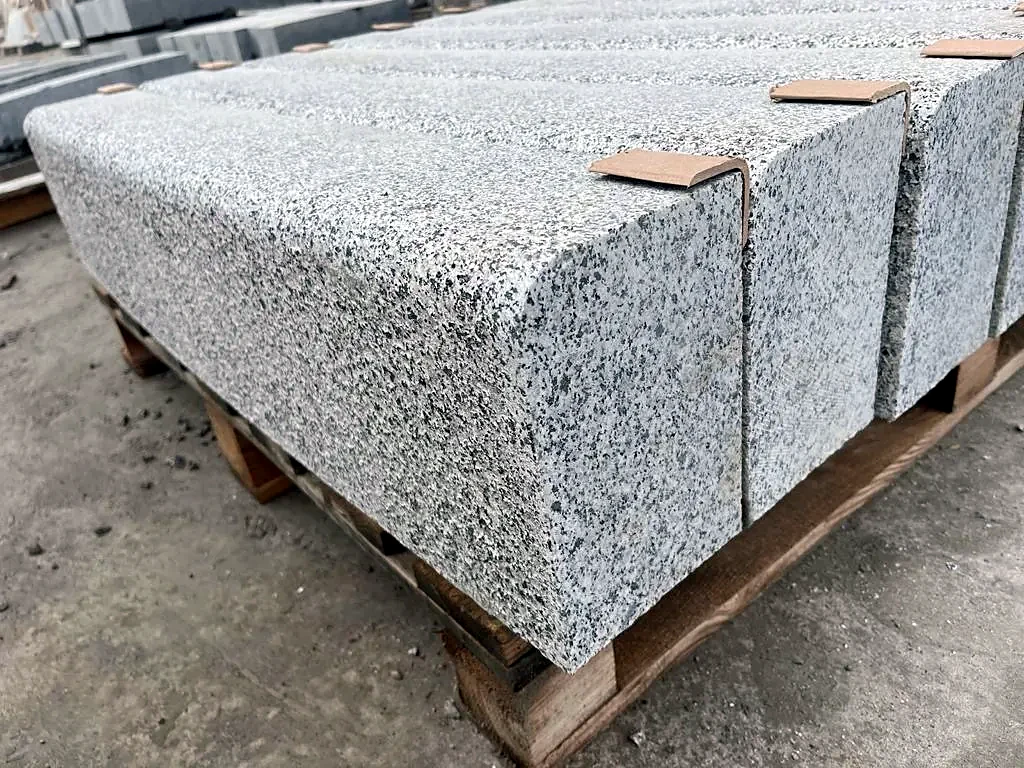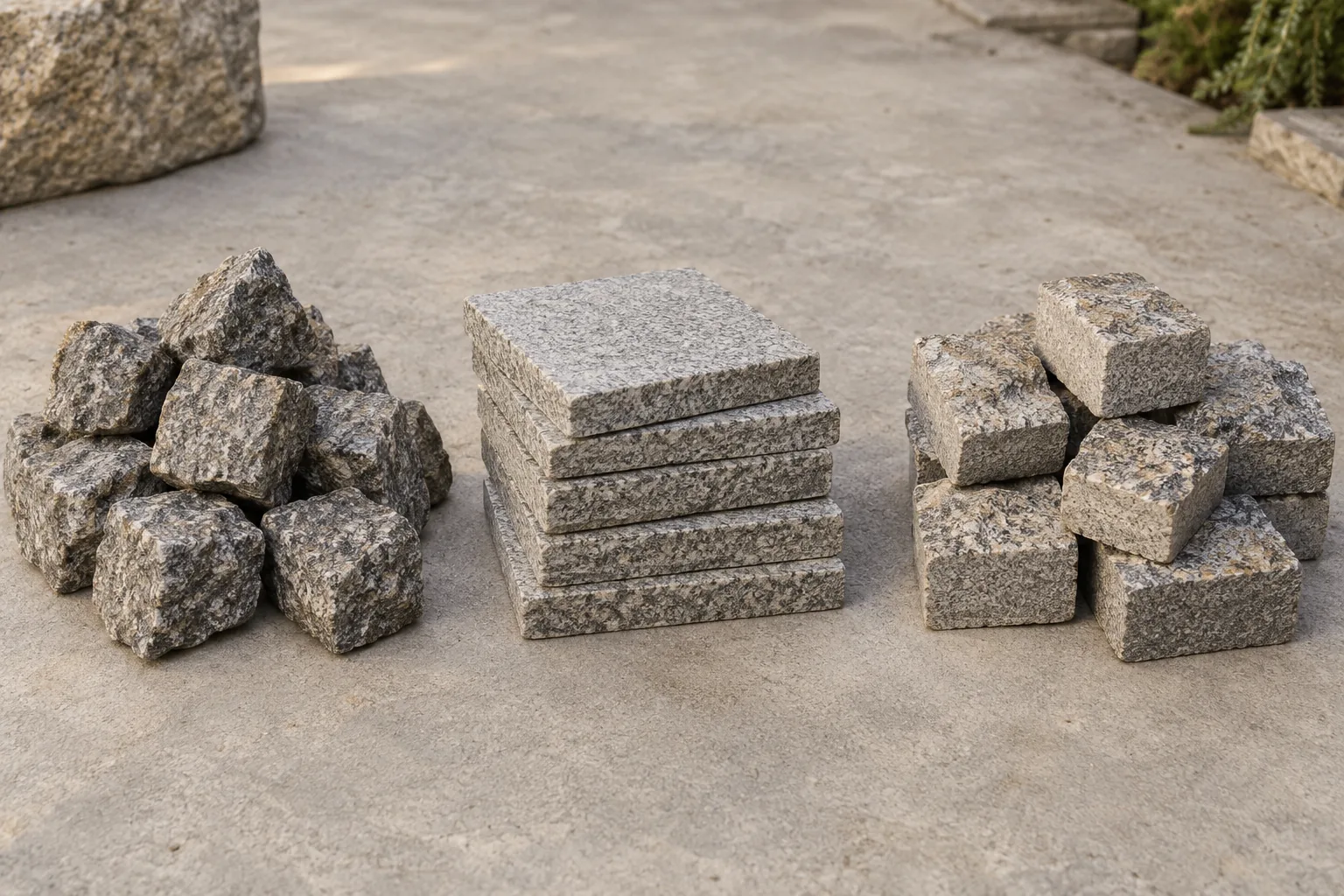
What actually differs?
These terms describe how the faces are produced. Stone from the same quarry can feel and look different after different processing.
| Type | Main distinction | What to confirm |
|---|---|---|
| Split setts | Textured faces with natural variation | Dimensional tolerances, joints and walking comfort |
| Sawn setts | Faces formed by cutting | Top-face finish, dimensions and project requirements |
| Sawn-and-split setts | A combination of cut and split faces | Exactly which faces receive each treatment |
NIKA GRAN describes its sawn-and-split paving as having sawn sides and a split top. Terminology is not identical across suppliers. A drawing or written face-by-face specification avoids misunderstandings.
Sawn and flamed are not opposites
Sawing determines geometry; flaming changes the surface texture. A sawn sett can therefore have a flamed top. This combination is worth considering when a project calls for relatively even outdoor paving with a textured walking face.
A flamed finish is not a promise that a surface cannot become slippery. Water, ice, contamination, gradient and maintenance all matter. Where the project specifies slip-resistance performance, request evidence for the chosen stone and finish rather than relying on a generic description.
Match the paving to its use
Garden paths. Compare split setts with sawn options using samples. Where wheelchairs, walking aids or small wheels will use the route, assess joints and level changes in the completed surface as well as the individual stones.
Terraces and entrance areas. Sawn units and paving slabs offer different layout options from small split setts. Specify the walking-face finish and the drainage arrangement before ordering.
Vehicle access. Do not choose thickness from a photograph or a universal rule. Loading, unit size, ground conditions, the supporting layers and the installation method need to be considered together by the responsible designer or installer.
Prepare a useful quotation request
Send the intended use, traffic type, measured area, layout, stone selection and required finishes. Include requirements for tolerances, joint widths and batch matching. Identify whether the project needs granite kerbs, then supply the delivery address and unloading constraints.
Cutting allowance should follow the layout rather than an arbitrary percentage. Approve an actual batch sample where colour consistency is important: a screen image is not a guarantee of the appearance of every stone.
Compare quotations on the same basis. Stone, preparation of the base, installation, accessories and transport should be identifiable costs—not a single unexplained price per square metre.
Frequently asked questions
Does sawn mean polished?
No. Sawing and polishing are separate processes. Confirm the finish of the top face explicitly.
Can different types be combined?
They can be incorporated into a coordinated design. Check thicknesses, finished levels, joints and transitions before placing the order.
Is one thickness suitable for every driveway?
No. The paving and its supporting construction must be selected for the actual loads and site conditions.
Explore paving and landscaping products or send a project enquiry.
Sources and scope
- NIKA GRAN paving catalogue: product range and stated processing options.
- Granite Setts UK finishes guide: processing terminology. That supplier's numerical tolerances and test values are not claims about NIKA GRAN products.
This guide helps with product specification; it is not a pavement structural design.