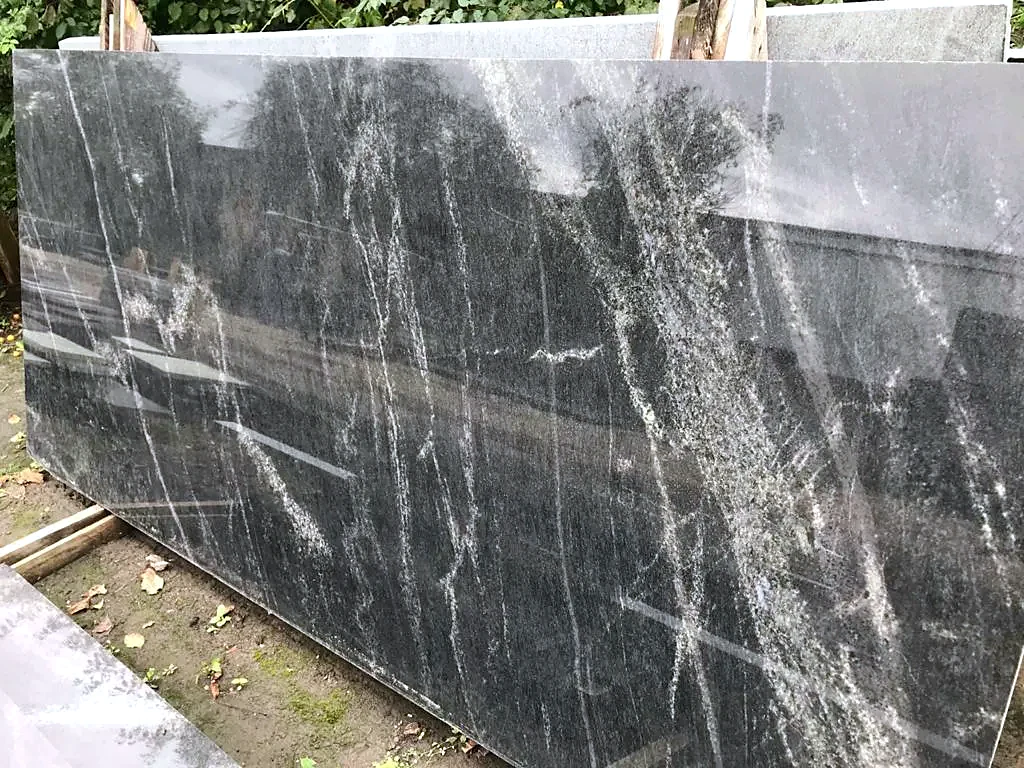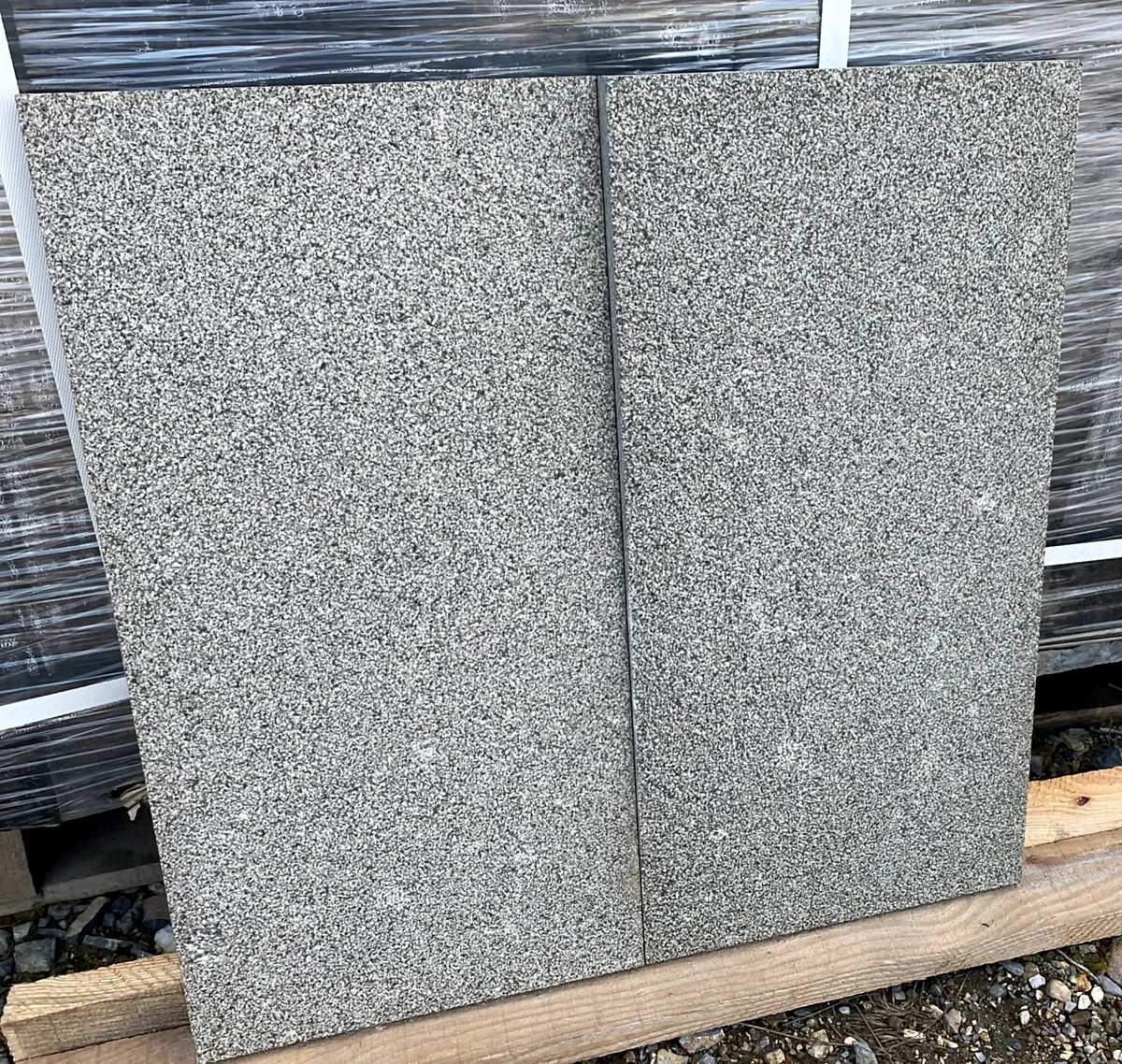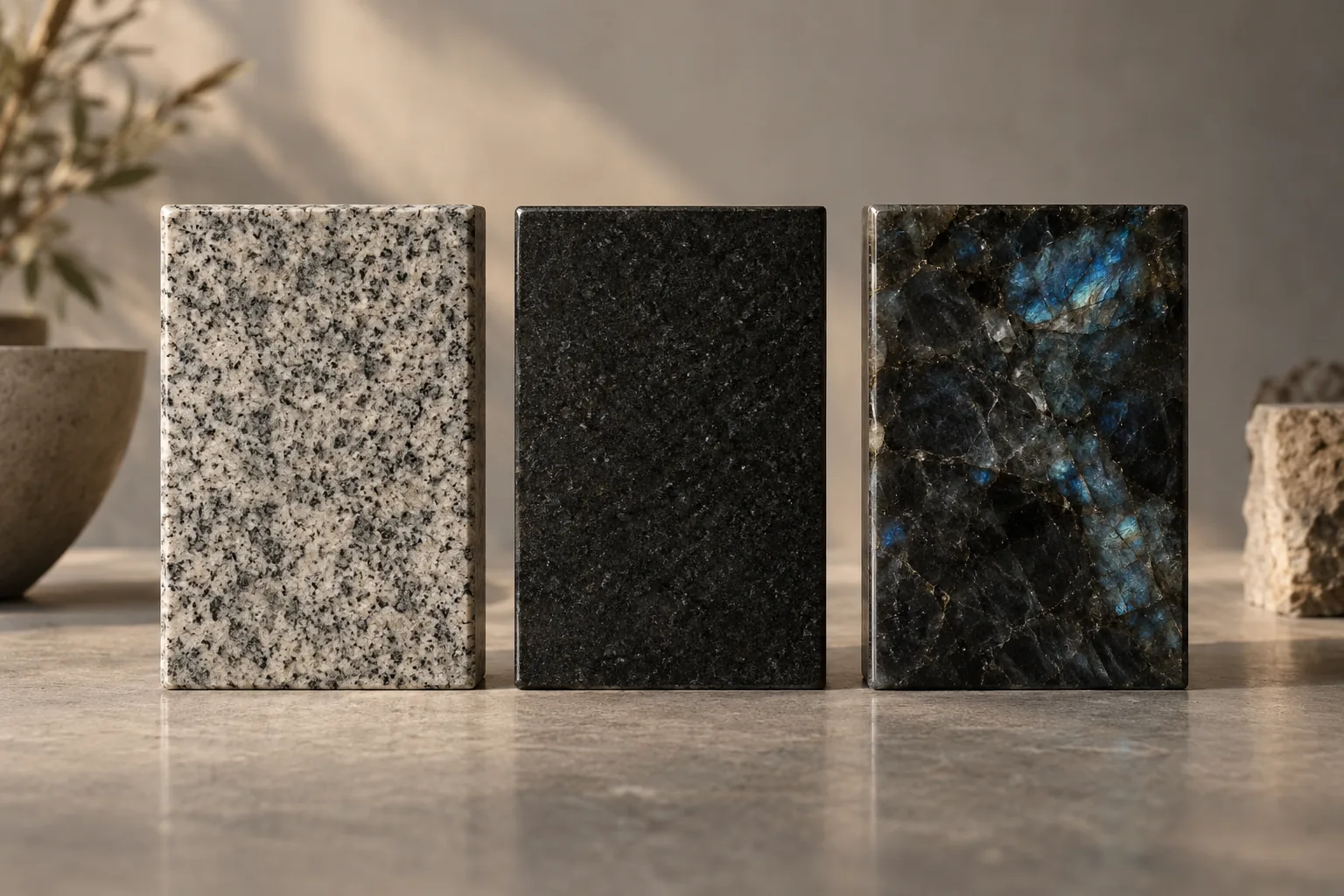
Validate quarry and trade names separately — the same stone is often sold under more than one commercial name.
Shared origin, different behaviour
All three are igneous rocks formed when magma cooled and solidified. Igneous origin alone does not establish suitability for exterior use: assess the actual material, finish, construction and exposure conditions. The differences follow from chemical and mineral composition, structure and grain size.
| Group | Typical appearance | Practical implication |
|---|---|---|
| Granite | light grey, pink, red; visible grain | general choice for paving, steps and façades |
| Gabbro | often dark; colour and grain size depend on the variety and sample | deep black polished surface, strong engraving contrast |
| Labradorite | dark with blue and blue-green flashes | feature surfaces, panels, memorial work |
On this site the groups are shown as separate materials: grey and coloured granites, Bukynske gabbro and Holovyne labradorite.
What actually drives the choice
Colour. Light granites work where strong contrast is undesirable. Black gabbro gives clear contrast with engraving and light joints. Labradorite changes noticeably with viewing angle — a property of the stone, not a defect.
Finish. Polishing reveals colour depth, honing produces a matt surface without reflections, and flaming creates a textured, rougher surface. For outdoor work the finish should follow the intended use rather than a screen image.
Batch. The pattern changes from block to block. Approve the shade against a physical sample from the current batch: a photograph conveys neither the fine grain nor the true shade.
Getting the name right
One stone can carry both a geological deposit name and a commercial name. For example, grey Pokostivka stone appears in public trade catalogues as Grey Ukraine, and some varieties carry several trade names with different suppliers. Order against a written specification — deposit, format, finish, batch — rather than a name alone.
The group name does not replace testing. Where a project specifies strength, water absorption, abrasion or slip-resistance values, ask for evidence for the exact material and finish instead of relying on a general claim that granite is durable.
Frequently asked questions
Is gabbro a granite?
They are different rock types with a related origin and different composition. In everyday speech “granite” is used for any dense decorative stone, but a specification should use the accurate name.
Can labradorite be used outdoors?
Yes, with a suitable finish and a check against the intended use. For wet areas and steps, pay particular attention to the surface texture.
How should quotes for different stones be compared?
Compare like for like: stone, format, thickness, finish, packing and logistics as separate lines. A single price per square metre without those details is not comparable.
Explore granite types and deposits or send your project details.
Sources and scope
- Magmatic rocks, Encyclopedia of Modern Ukraine — definition and origin of the rock group.
- NIKA GRAN granite types — product range and applications.
This guide supports specification work; it does not replace approval of a physical sample or material documentation.
Editorial clarification, 15 October 2026: sources are used only within verified content; the unverified handbook citation is not used.