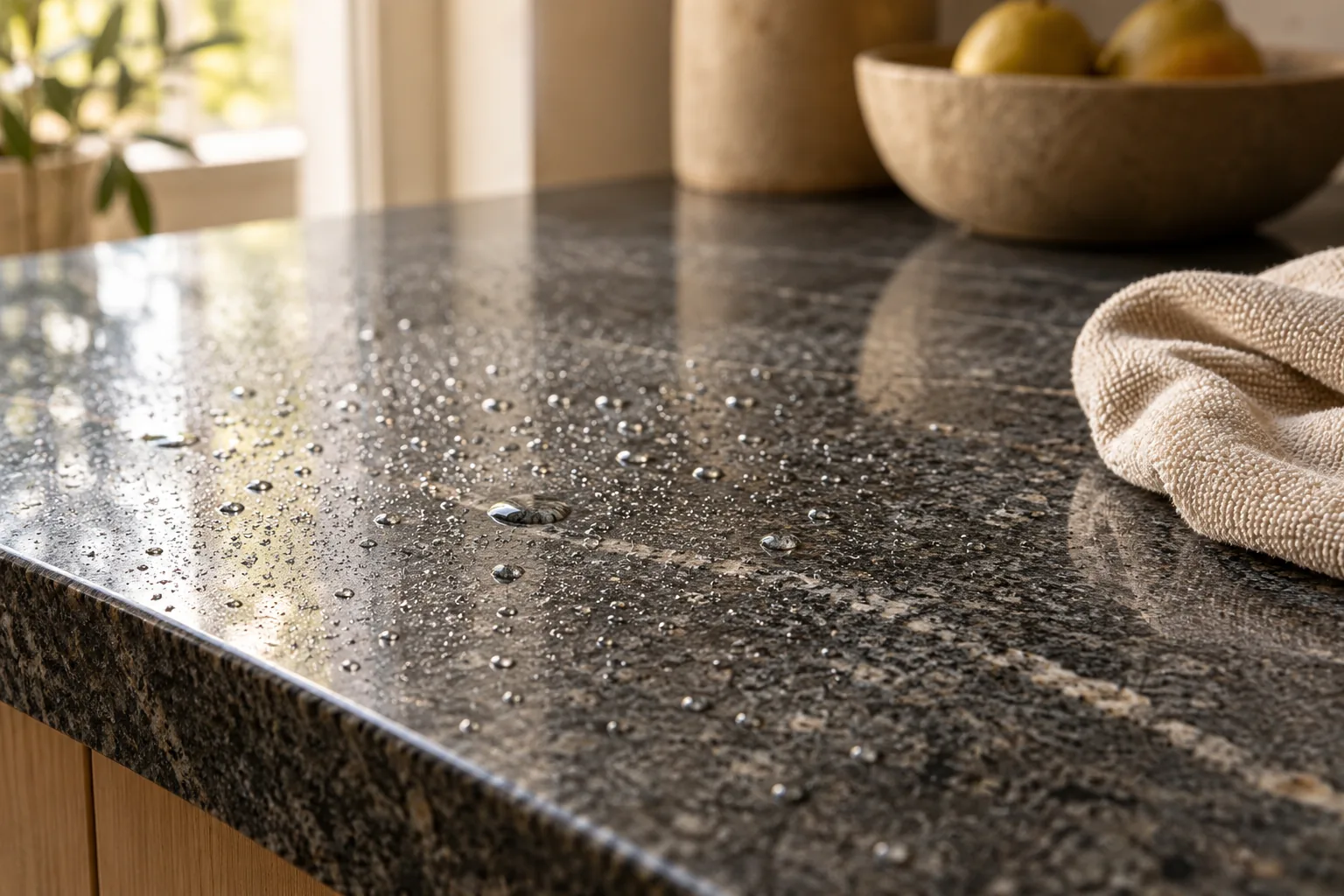
Acidic cleaners, stiff brushes and scouring powders can damage the surface or a joint, so avoid them.
Daily routine
Wipe with a damp cloth or soft sponge. For greasy marks use a neutral cleaner approved for the actual stone and treatment, then rinse with clean water. Do not let detergent dry on the stone — dried residue, not the stone, creates film and streaks.
| Mark | Do | Do not |
|---|---|---|
| Dust, fingerprints | water and a compatible neutral cleaner, then a dry soft cloth | use an abrasive powder |
| Grease and oil | compatible neutral cleaner, rinse as instructed | leave cleaner on the surface |
| Coffee, wine | blot at once, rinse, dry | scrub with a dry cloth |
| Limescale near a sink | mild cleaner per manufacturer instructions | strong acids without checking |
Why chemistry matters
Granite consists of several minerals, and a surface can react differently to different substances. Strong acids and alkaline cleaners can change gloss or leave marks, and the appropriate restoration method depends on the cause and should be agreed with a stone professional. For deeper cleaning, test any product on an inconspicuous area first, and involve a stone professional for a difficult case.
Treat sealers and impregnators with the same care. There is no single universal application interval for every material and condition: the product manufacturer and the stone supplier should confirm whether sealing is appropriate for your surface and finish.
Is sealing necessary, and should oil be applied?
An appropriate impregnator can reduce water and grease absorption, but it does not make stone stain-proof or replace cleaning. Do not set a universal reapplication schedule without identifying the stone, finish, previous treatment and product instructions.
Cooking oil or a wooden-worktop oil is not a substitute for a granite impregnator. Do not apply it to refresh the stone without manufacturer confirmation: oil can leave a stain. A search query about worktop oil is not advice to use it.
Confirm compatibility, preparation and drying, time before use, and any food-contact requirements. Some products are restricted to professional use. The cited Lithofin product is an example of product-specific instructions, not a universal recommendation or a NIKA GRAN product.
What to do when a mark remains
Blot the spill, use an approved cleaner and inspect after drying. If the mark remains, record photographs, the spilled substance and products already used. Do not mix cleaners or try abrasive polishing at random: dullness may be residue, finish damage or another issue. A professional selects the method after inspection.
Habits that preserve the surface
- Use trivets for hot pans: a sharp temperature change is undesirable for any stone.
- Cut on a board rather than directly on the worktop.
- Wipe up vinegar, lemon juice, wine and bathroom cleaners immediately.
- Do not drag heavy items without a protective layer.
- Use a mat around the sink and dry any water that reaches a joint.
Frequently asked questions
Does the surface need regular polishing?
No. Cleaning is enough for everyday use. Polishing is done when visible scratches or loss of gloss appear.
Does granite stain?
A dense polished surface resists most household marks, but oils and dyes left for a long time can leave a trace, particularly on matt finishes.
Can steam be used?
Do not assume a steam cleaner is suitable from the stone name alone. Unless the manufacturer or fabricator confirms compatibility with the actual surface, treatment and joints, avoid steam and use a soft cloth with a compatible neutral cleaner for routine care. This is a precaution, not a claim that steam damages every granite.
Explore worktops and window sills or request a quotation.
Sources and scope
- Use Natural Stone: How to Care For Your Granite Countertops — general principles for natural stone care.
- NIKA GRAN interior range: plates and interior products.
This guidance is general. Follow the manufacturer's instructions for a specific product, and consult a specialist for a difficult stain.
Lithofin MN Stain-Stop — manufacturer instructions; professional use only
Editorial clarification, 15 October 2026: steam use now requires a compatibility check; no universal impossibility of household restoration is claimed. Sources were reviewed for content, not merely HTTP status.