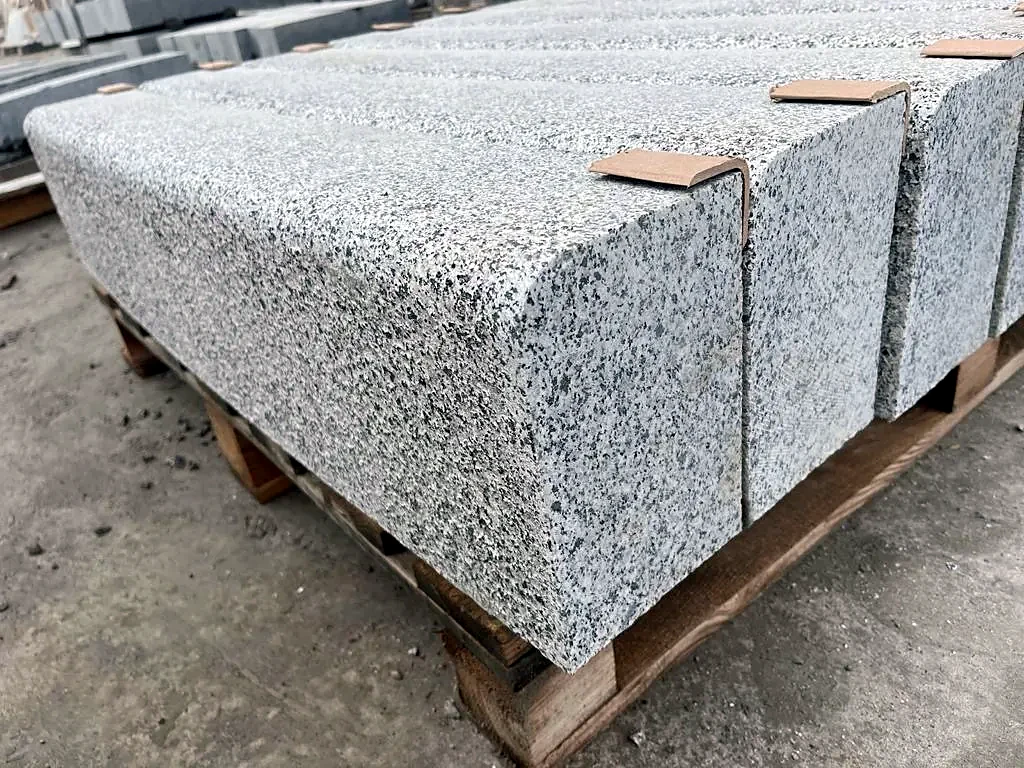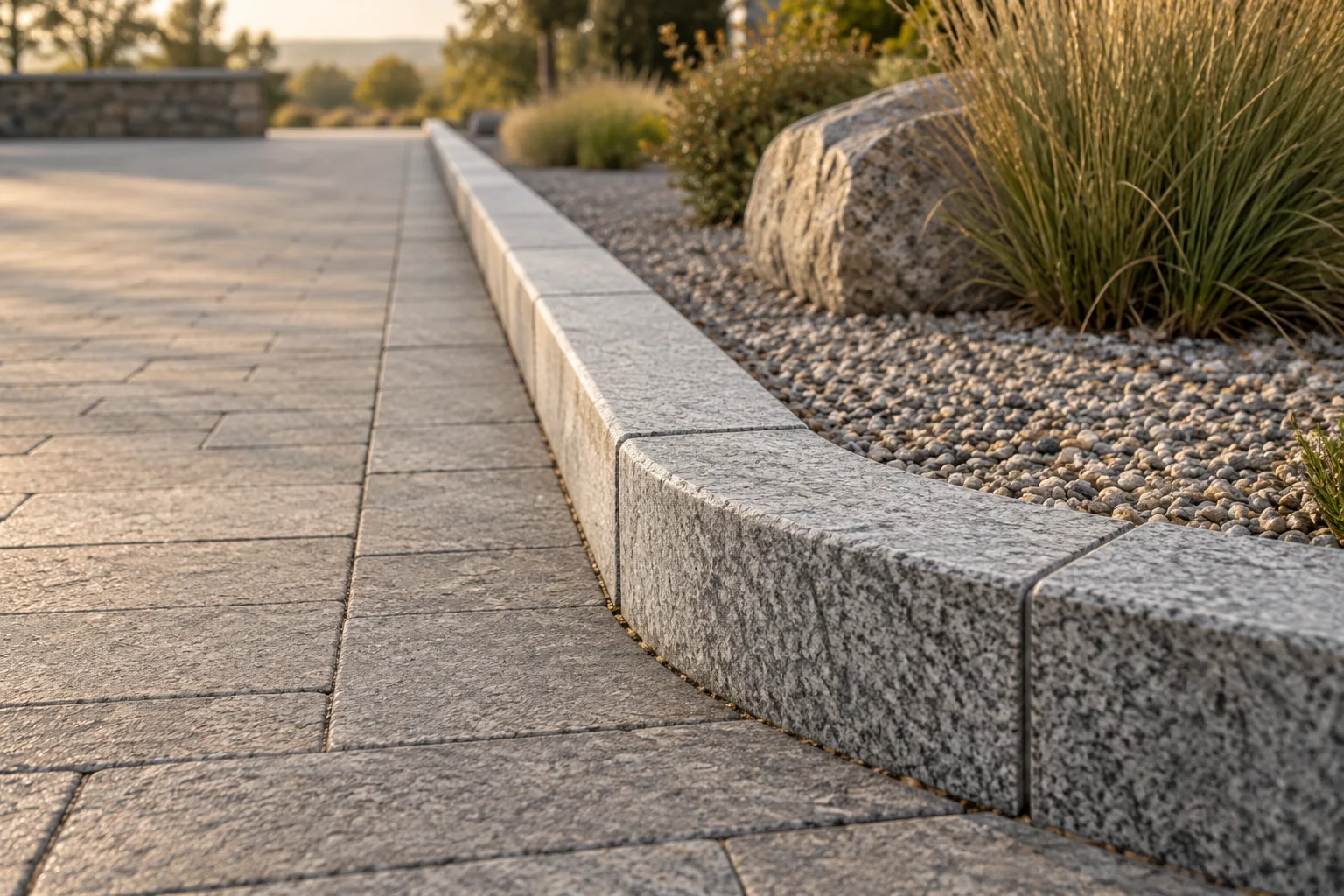
Straight units cover the main runs, radiused units handle curves, and the joints determine how the finished line looks.
What the specification contains
| Item | What to state |
|---|---|
| Cross-section | width, height, top edge profile |
| Length | standard or project-specific |
| Finish | sawn, flamed, split |
| Radius | radius and arc length for curved runs |
| Edges | chamfer, round, profile |
| Joint | square, angled, cut on site |
We produce granite kerbs to standard or individual sizes; stone, finish and packing are agreed before production. See the granite kerbs page.
Straight and radiused units
A straight kerb is simple to estimate: length multiplied by the number of runs. A radiused kerb needs a layout, because the radius determines each unit’s length and the number of joints.
Two approaches are common:
- Built-up curve from shorter straight units — the line is faceted; compare cost for the actual geometry, component count and work scope.
- Radiused units — a smooth arc, more demanding to produce.
The choice affects both appearance and installation effort, so it belongs in the design stage.
Common ordering mistakes
- Ordering “metres of kerb” without cross-section or unit length.
- Forgetting radii and corners, then cutting on site.
- Not matching the top-edge finish to the paving finish.
- Ignoring a cutting allowance calculated from the layout rather than a blanket percentage.
- Ordering the exact count with no allowance for transport and packing.
Packing and logistics
Kerbs are heavy and bulky. Packing, unloading method and site handling equipment should be planned as separate items; they are not automatically included in the stone price.
Frequently asked questions
Do you produce kerbs from drawings?
Yes, to standard or individual sizes. We need cross-sections, lengths, radii and junction locations.
Which finish should be chosen?
Sawn or flamed surfaces are common for roads and footways; split finishes may suit landscape work.
Can kerbs be combined with other stone?
Yes, but agree thicknesses, levels and joints to avoid awkward steps.
Explore paving and kerbs or send a specification.
Sources and scope
- NIKA GRAN granite kerbs — range and stated finishes.
- Granite Setts UK: finishes — finish terminology.
Pavement structural design is carried out by the designer; this guide helps prepare a product order.