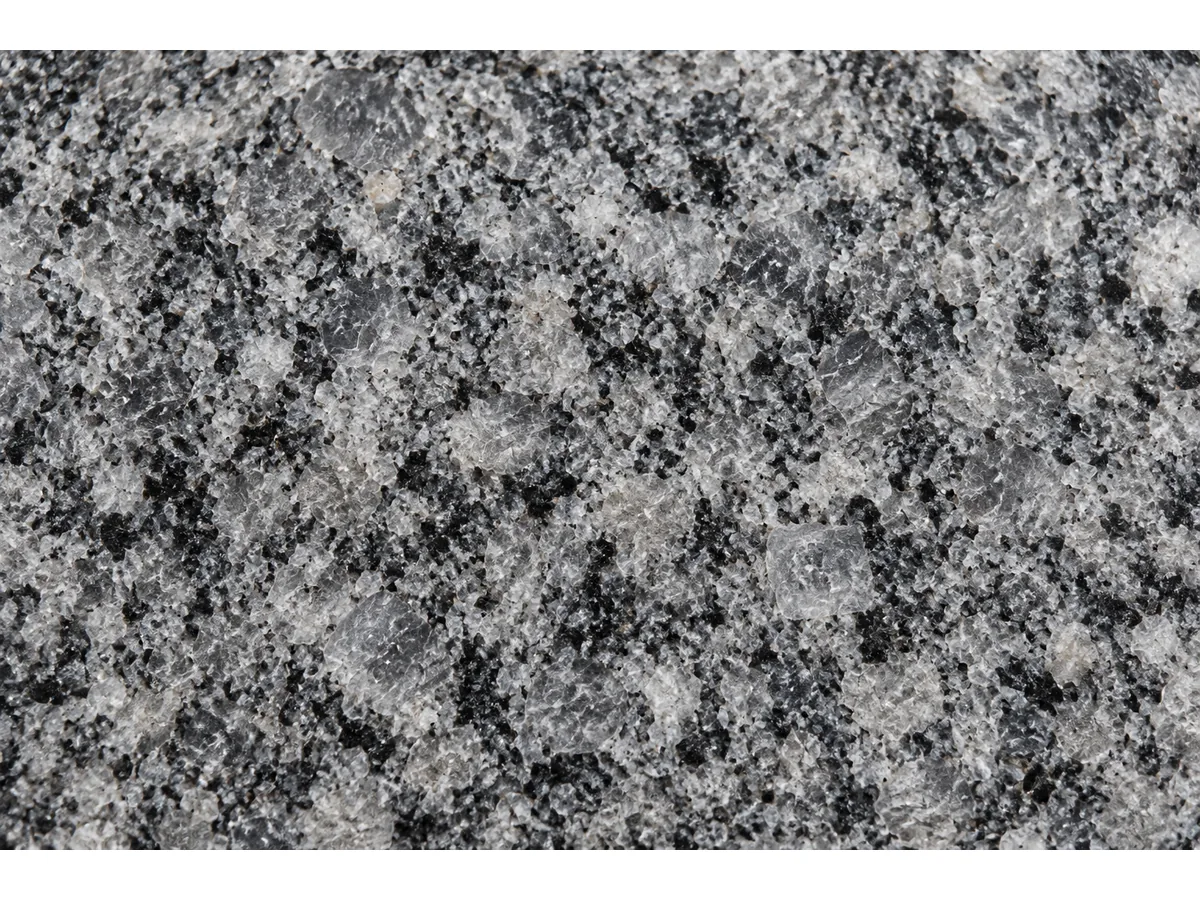
Granite is an igneous (intrusive) rock with a granular structure, composed mainly of quartz, feldspar and mica, and formed when magma cools slowly deep underground.
How granite forms
Magma that never reaches the surface solidifies within the Earth's crust. Because the cooling is slow, minerals have time to grow into crystals visible to the naked eye. That is what gives granite its granular, sugar-like texture instead of a uniform glassy mass. Faster cooling would produce a different rock, finer-grained or volcanic in origin.
What granite is made of
Its mineral composition shapes both the appearance of the stone and the way it behaves in use. There are three main components:
- Quartz — the hardest of them; it provides abrasion resistance and the deep shine that appears after polishing.
- Feldspar — the most abundant mineral; it sets the base colour of the rock.
- Mica — forms small shining flakes that add depth and sparkle to the texture.
Properties and uses
Granite is dense, strong, takes polish well and resists abrasion and frost. That is why it is used in construction, landscaping, interiors and memorial products — from paving and steps to countertops and monuments. The stone tolerates moisture, temperature swings and constant load. You can read more in the granite section.
Why granite comes in different colours
The colour is determined by the feldspar composition: grey, pink, red or brown. Dark stones such as labradorite and gabbro are close relatives rather than true granites, yet trade practice often groups them under the same name.
Ukrainian deposits and precise names
NIKA GRAN works with Ukrainian stone: Pokostivske, Leznykivske, Didkovytske and Maslavske granite, as well as Holovynskyi labradorite and Bukynske gabbro. We state the precise rock names even though trade catalogues may simply call them all granite.
Choosing the right stone
Natural stone varies in shade and pattern from batch to batch, which is normal and part of its character. A sample should therefore be agreed in advance. Browse the shop, check indicative prices, use the calculator, or send a request through the feedback form.
Frequently asked questions
What is granite?
Granite is an igneous, or intrusive, rock with a granular structure. It is composed mainly of quartz, feldspar and mica and forms when magma cools slowly deep underground, which gives it its characteristic sugar-like texture.
What minerals is granite made of?
The main components of granite are quartz, feldspar and mica. Quartz is the hardest and provides abrasion resistance and a deep shine after polishing; feldspar sets the base colour of the rock; mica forms small shining flakes that add depth to the texture.
How does granite form in nature?
Granite forms when magma that never reaches the surface solidifies within the Earth's crust. The cooling is slow, so minerals grow into crystals visible to the naked eye. Faster cooling would produce a finer-grained or volcanic rock instead.
What determines the colour of granite?
The colour of granite is determined by its feldspar composition. It can be grey, pink, red or brown, and the pattern within one rock may be even, spotted or banded. Dark stones such as labradorite and gabbro are close relatives rather than true granites.