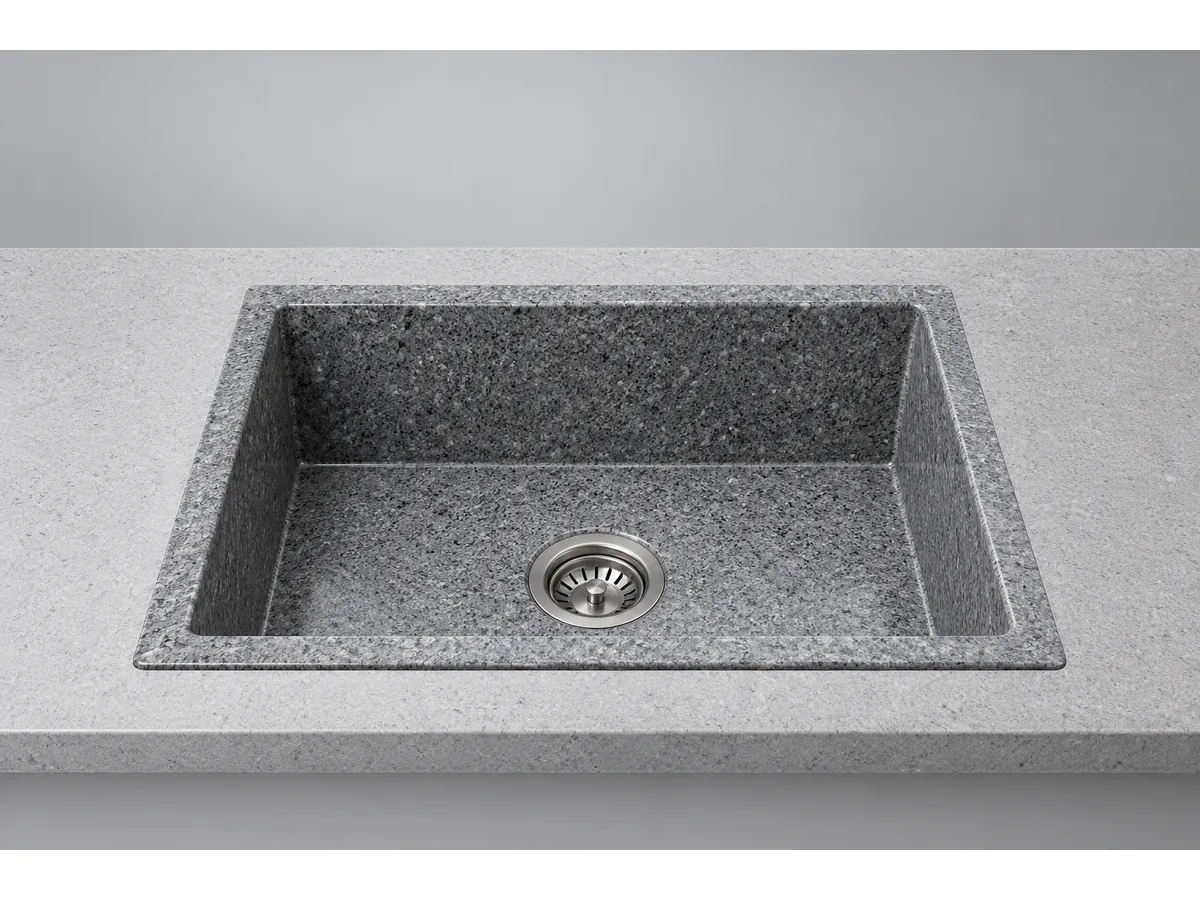
How does natural stone differ from composite?
These are two different materials, and they should not be confused. Natural stone means a solid sink carved from granite or marble, or an inset stone sink. Composite is an artificial material with a polymer binder and a mineral filler, such as granite chips. Composite is produced in ready-made shapes, so its sizes are limited to the model range. Natural stone is made to the dimensions of a specific worktop, so there are fewer seams and joints.
Which material behaves better in a kitchen?
Both materials work — the question is what matters more to you. Natural stone resists abrasion, and when needed it can be ground and polished. Composite is non-porous and practically does not absorb water, but it does not like overheating, and strongly colouring liquids leave marks on it; scratches on composite do not polish out.
- Origin: natural stone is granite or marble; composite is a mineral filler with a polymer binder.
- Production: stone is made to worktop dimensions; composite comes in ready-made shapes within a model range.
- Seams and joints: a solid stone sink has fewer of them.
- Water: composite practically does not absorb it; stone is porous, so the right finish matters.
- Surface: stone can be ground and polished; scratches on composite do not polish out.
- Limits: composite does not like overheating, while stone needs natural stone care products.
What should you know about care?
Stone is porous, so choosing the right finish and care matters. Do not leave colouring liquids on it for long, and use products for natural stone. Composite is non-porous and hardly absorbs water, but it does not like overheating, and strongly colouring liquids leave marks on it. Both materials need regular care, not only the right choice at purchase.
How do you match the sink to the worktop?
A natural stone sink is made together with the worktop — that makes cutouts, rims and joints easier to coordinate. We work with Ukrainian stone types: Pokostovskyi, Leznykivskyi, Didkovytskyi and Maslavskyi granite, Golovynskyi labradorite, and Bukynske gabbro. Cutouts for the sink, tap and appliances are fixed in the specification before production, not estimated by eye.
How do you order a sink together with a worktop?
The order works like this: you prepare a specification — product type, stone, format, finish and quantity. We then confirm the order and make the calculation, after which the price, format and packaging are agreed before production. See interior products and worktops, the general catalogue and the prices page, and send your drawing through feedback — we will make the sink together with the worktop to your dimensions.
Frequently asked questions
Granite sink or composite — which is better?
Both materials work; the difference is in their properties. Natural stone is a solid sink carved from granite or marble, it resists abrasion and can be polished, while composite is non-porous and hardly absorbs water but does not like overheating, and scratches on it do not polish out.
What is a composite sink?
It is a product made of an artificial material with a polymer binder and a mineral filler such as granite chips. Composite comes in ready-made shapes within a model range, while natural stone is made to the dimensions of a specific worktop.
How do you care for a granite sink?
Stone is porous, so use products for natural stone and do not leave colouring liquids on it for long. Choosing the right finish and caring for it regularly matters more than the choice at purchase alone.
Can you order a sink together with a worktop?
Yes, a natural stone sink is made together with the worktop, which makes cutouts, rims and joints easier to coordinate. Cutouts for the sink, tap and appliances are fixed in the specification before production, not estimated by eye.