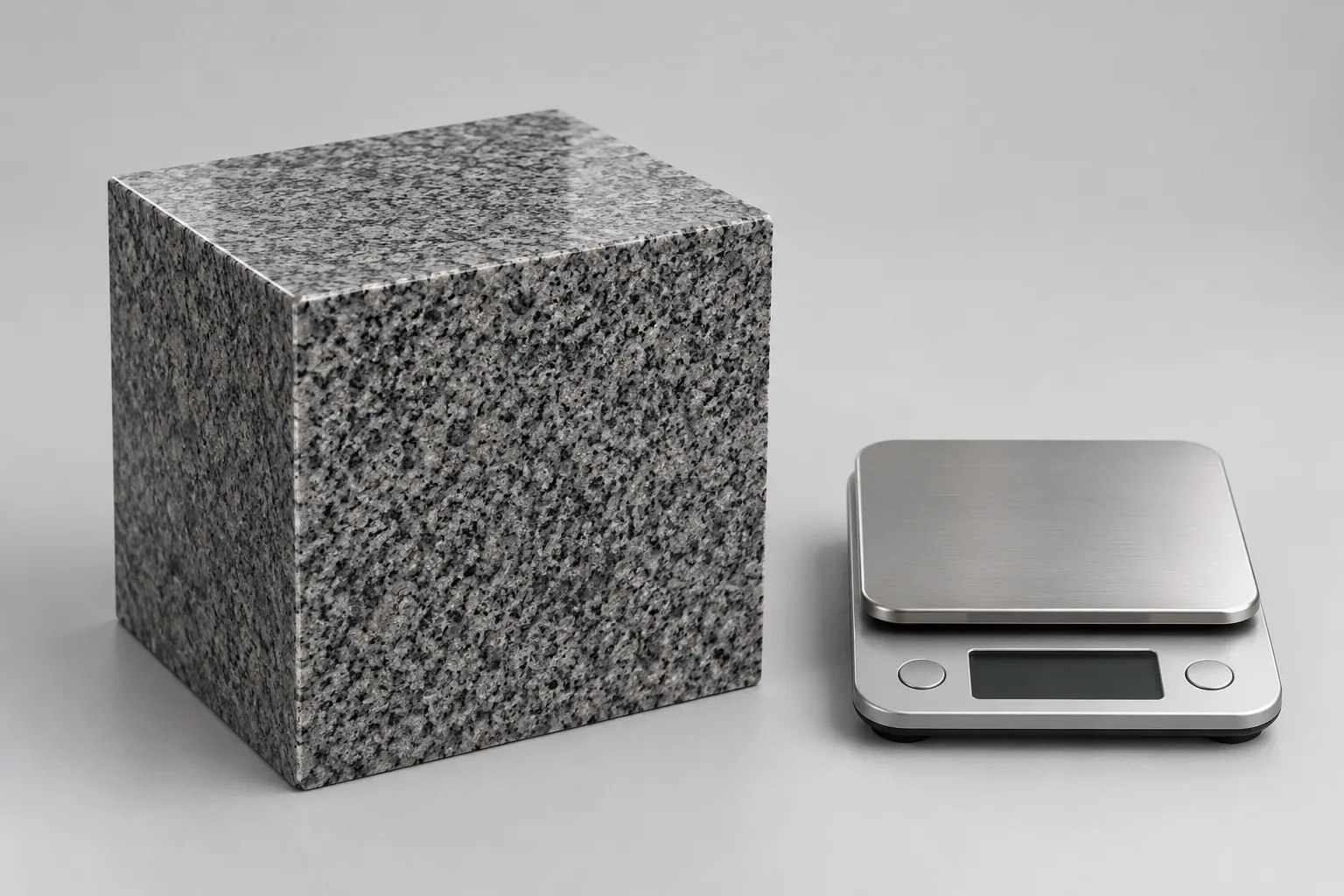
Granite is a dense natural stone, and its properties determine where and how it is used: in construction, landscaping, interiors and memorial products. Below — about granite density, weight, hardness, shine and radiation background.
What is the density of granite?
The density of most granites lies in the range of 2500–2800 kg/m³ — reference data for building materials. The value depends on mineral composition: more quartz and feldspar means higher density, more mica means somewhat lower.
How much does 1 m³ of granite weigh?
The weight of a cubic metre of granite is about 2.5–2.8 tonnes. This is a calculated value following from the density range. For a particular batch of stone the value may differ slightly, so for an accurate calculation of products and delivery use the weight calculator on the site.
How hard is granite?
Granite hardness is high: the stone resists abrasion and scratching well, which is why it is used in paving, on outdoor steps and in places with constant load. We do not give specific numerical values on the hardness scale — what matters more is how the stone behaves in real use.
What shine does polishing give?
Granite polishes to a mirror shine. Granite shine depends on the mineral composition of the rock and the quality of polishing: more quartz means a deeper and clearer reflection, and a uniform structure gives an even gloss. On steps and platforms a polished surface is often combined with a thermally treated or honed finish for safety.
Is the radiation background of granite checked?
The radiation background of granite is a natural property of the stone. Its radiation characteristics are checked at extraction and delivery, and building materials are subject to norms. We do not give specific values in Bq/kg — what matters is that the check is carried out and the stone is supplied with confirmed characteristics.
What affects the weight of a specific item
- Rock — different granites have different densities.
- Format — area and shape of the piece.
- Thickness — the thicker the slab, the heavier it is.
- Finish — polishing removes a thin layer, thermal treatment and bush-hammering change the relief and mass only slightly.
You can calculate the weight and quantity of material in the calculator. An order starts with a specification: send the list of products, the stone type, format and finish. We will confirm that the pieces can be made and prepare a quotation — price, format and packaging are agreed before production begins. Send your request through the feedback form, conditions are on the terms page.
Frequently asked questions
How does density differ from the specific weight of granite?
Density is the mass of a unit volume in kilograms per cubic metre, while specific weight is the same characteristic expressed in other units. For granite both terms describe the same thing: most granites fall in the 2500–2800 kg/m³ range.
Does the weight of an item depend on the surface finish?
Only slightly. Polishing removes a thin surface layer, thermal treatment and bush-hammering change the relief, but they do not significantly affect the mass. The main contribution comes from the rock, the format and the thickness of the piece.
Is granite checked before use in interiors?
Granite is a natural stone; its radiation characteristics are checked at extraction and delivery, and building materials are subject to norms. We do not give specific values; what matters is that the check is carried out and the stone is supplied with confirmed characteristics.
Can a stone sample be approved in advance?
Yes, a sample is approved in advance, before production starts. Natural stone changes in shade and pattern from batch to batch, so a sample gives an idea of how the finished piece will look.