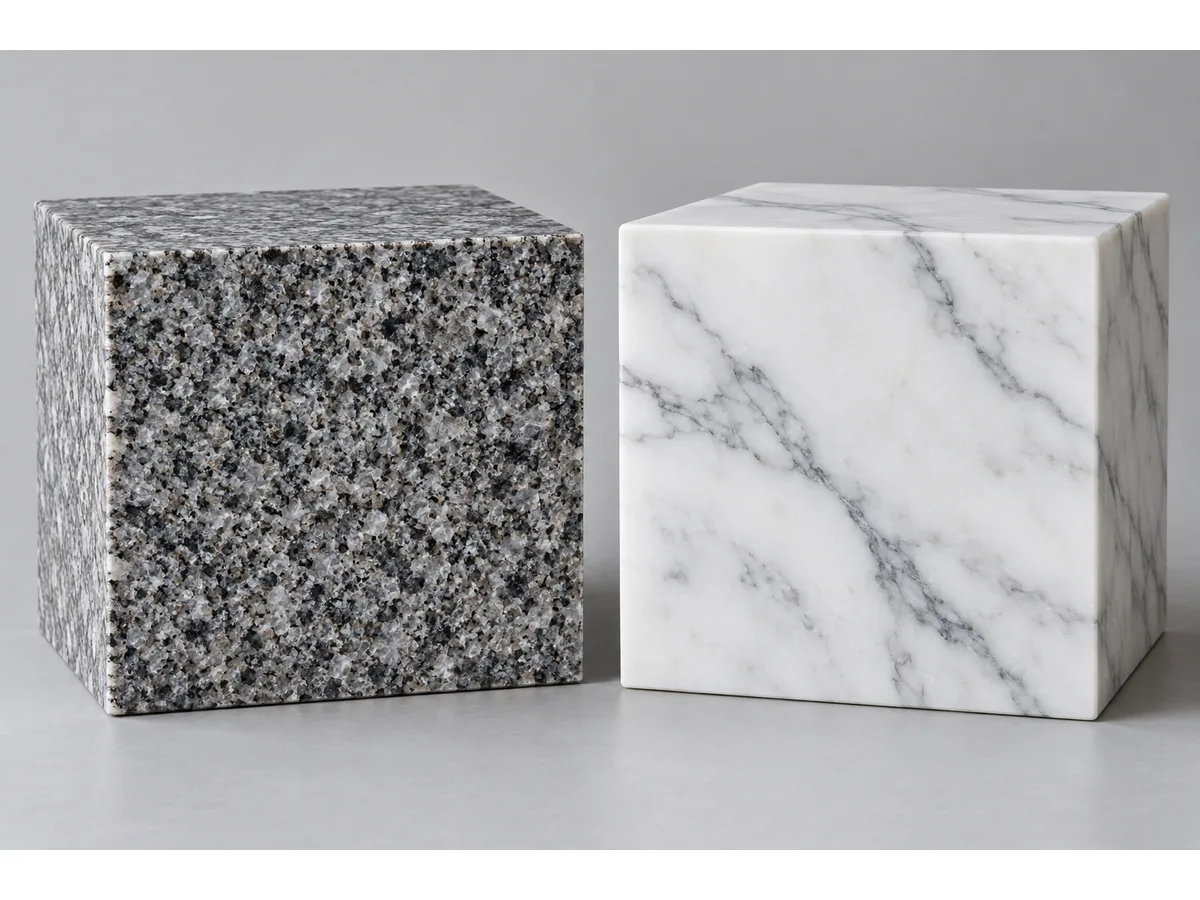
What is the difference between granite and marble?
Granite is an igneous rock: quartz, feldspar and mica crystallised from melt deep in the crust. Marble is metamorphic — limestone recrystallised under pressure and heat. That difference in origin explains the rest: structure, density, how each stone behaves under load and how it reacts to moisture and chemistry.
Which is stronger, granite or marble?
Granite is harder, denser and more abrasion-resistant than marble. Quartz and feldspar give it a tougher framework, and lower porosity means moisture and dirt penetrate the surface more slowly. Marble is softer: it scratches more easily, and acids — from household spills to urban rainfall — leave marks on it. This does not make marble a poor material; it simply performs best in different conditions.
Which is better for a monument?
For outdoor monuments, paving, window sills and countertops, granite is chosen more often: it is less porous, resists abrasion and reacts less to moisture, frost and street chemicals. Marble is also used in memorial sculpture and decorative work, but for permanent outdoor exposure granite is the more common choice, because it holds its geometry, polish and carving detail longer. The final decision is always the customer's: weigh where the piece will stand and how long it should keep its appearance. Granite memorial products are collected in the memorial range.
Granite vs marble at a glance
- Origin: granite is igneous; marble is metamorphic.
- Composition: granite — quartz, feldspar, mica; marble — recrystallised limestone.
- Hardness and density: higher in granite.
- Porosity: granite is less porous and resists moisture better.
- Abrasion: granite wears more slowly.
- Acids: marble is sensitive; granite is far more resistant.
- Typical use: granite for outdoors, paving, sills, countertops and outdoor monuments; marble for interiors, decoration and sculpture.
How to choose and approve the stone
Natural stone varies in shade and pattern from batch to batch — even within one type. That is why a sample is approved in advance, before production starts rather than after. NIKA GRAN works with granite: Pokostivskyi, Leznykivskyi, Didkovytskyi and Maslavskyi granite, Holovynskyi labradorite, Bukynske gabbro. We do not produce marble, so if marble is what you need, we will say so honestly at the quotation stage. See the granite section for stone types and finishes, and the catalogue for ready items.
How to place an order
The sequence is simple: you send a specification, we confirm it and prepare a quotation, and the price, format and packaging are agreed before production. If you need advice on which granite suits your conditions, write to us through the contact form. Current cooperation terms are described under terms, and prices for specific items are listed under prices.
Frequently asked questions
How do granite and marble differ?
Granite is an igneous rock, while marble is metamorphic. Granite consists of quartz, feldspar and mica that crystallised from melt deep in the crust, whereas marble is limestone recrystallised under pressure and heat. That difference in origin explains their structure, density and behaviour.
Which stone is stronger, granite or marble?
Granite is harder, denser and more resistant to abrasion than marble. Quartz and feldspar give it a tougher framework, and its lower porosity slows the penetration of moisture and dirt into the surface. Marble is softer, scratches more easily and is more sensitive to acids.
Which stone is better for an outdoor monument?
For outdoor monuments granite is chosen more often. It is less porous, resists abrasion and reacts less to moisture, frost and street chemicals, so it keeps its geometry, polish and carving detail longer. Marble is used more often for interiors, decoration and sculpture.
Can I see and approve the stone before ordering?
Yes, a sample is approved in advance, before production starts. Natural stone varies in shade and pattern from batch to batch even within one type, so viewing a sample shows how the finished piece will look. Advice on the right stone for your conditions is available at the quotation stage.