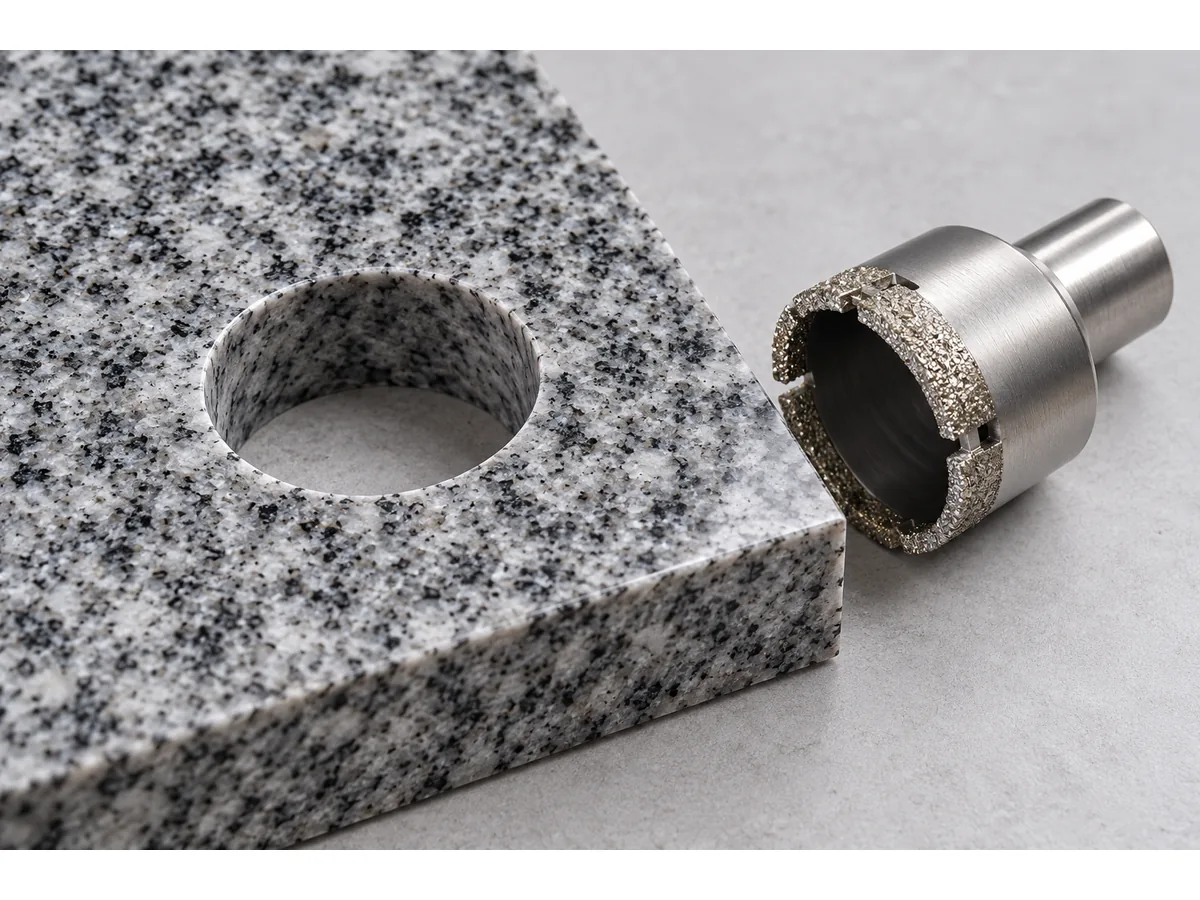
How to drill granite: the short answer
Granite is a dense natural stone, so drilling calls for diamond tooling with continuous water cooling. Hammer mode and ordinary masonry bits do not work here: they do not cut the stone, they crush it, which leaves a ragged hole edge and raises the risk of cracking. Pick the specific tool for the job — hole diameter and depth, slab thickness, and where the hole sits.
Which drill bit works for granite
For granite, use diamond drill bits and cores made for stone. Continuous water cooling is essential: it carries heat away and keeps the diamond layer from glazing over. Without water the cutting edge loses its bite quickly, so in everyday conditions work wet or with a water-fed tool, and use dry drilling only with dust extraction. Settle the diameter, depth and slab thickness before you start — that is what determines the core you need. Slabs and blocks in various formats are gathered under plates, slabs and blocks, and finished pieces under the catalogue.
Stone adhesive: what to glue granite with
Use adhesives intended for natural stone. Ordinary tile adhesive can leave marks and stains, especially on lighter stones: it soaks into the surface and shows up once it dries. Match the adhesive to the material and the conditions — indoors or outdoors, whether the piece carries load, and how thick the joint needs to be. It also matters whether you are bonding stone to stone or stone to another base: interior work such as worktops, sills and stairs tends to call for one family of products, outdoor work for another. Typical solutions are shown under interior pieces, and we recommend agreeing the exact product with us, because there is no single universal answer.
Safety essentials
- Granite dust contains crystalline silica, so wear a respirator rather than a simple cloth mask.
- Protect your eyes with goggles or a face shield — cutting and drilling throw fragments.
- Use hearing protection; sustained tool noise damages hearing.
- Work with water cooling or dust extraction; dry cutting without extraction is not acceptable.
- Never drill or cut a piece while holding it: clamp the stone securely.
- Wear gloves and keep slurry off your skin and out of your eyes.
Plan holes and cut-outs before production
Thickness, format and the purpose of each piece affect how it is fixed. Drilling a finished piece is harder and riskier than planning holes at the factory: polished surfaces chip more easily, and concealed fixings demand precise positions. That is why holes, cut-outs and concealed fixing points are agreed at the ordering stage, together with the specification.
Ordering a piece with ready-made holes and cut-outs
We make pieces to an agreed specification: product type, stone, format, finish and quantity. If you need holes or cut-outs, add them to the specification and, where possible, a dimensioned drawing — we will plan them into production. The order runs like this: specification → confirmation and estimate → price, format and packaging agreed before production. Working terms are set out on the terms page and pricing on the prices page. If you are unsure which tool or adhesive suits your task, write to us through feedback and we will advise.
Frequently asked questions
How do you drill granite?
Drill granite with diamond tooling under continuous water cooling. Hammer mode and ordinary masonry bits do not work: they crush the stone instead of cutting it, leaving a ragged hole edge. The exact tool is chosen for the job and for where the hole sits.
Which drill bit works for granite?
Use diamond drill bits and cores made for stone. Continuous water cooling is essential, because without it the diamond layer glazes over and loses its bite. Work wet or with a water-fed tool, and use dry drilling only with dust extraction.
What glue works for granite?
Use adhesives intended for natural stone. Ordinary tile adhesive can soak into the surface and leave marks or stains, especially on lighter stones. Match the product to the material and the conditions, and it is best to agree the exact one with us.
How can you drill granite safely?
Wear a respirator, eye protection, gloves and hearing protection. Granite dust contains crystalline silica, so a simple cloth mask is not enough. Clamp the piece securely instead of holding it, and work with water cooling or dust extraction.