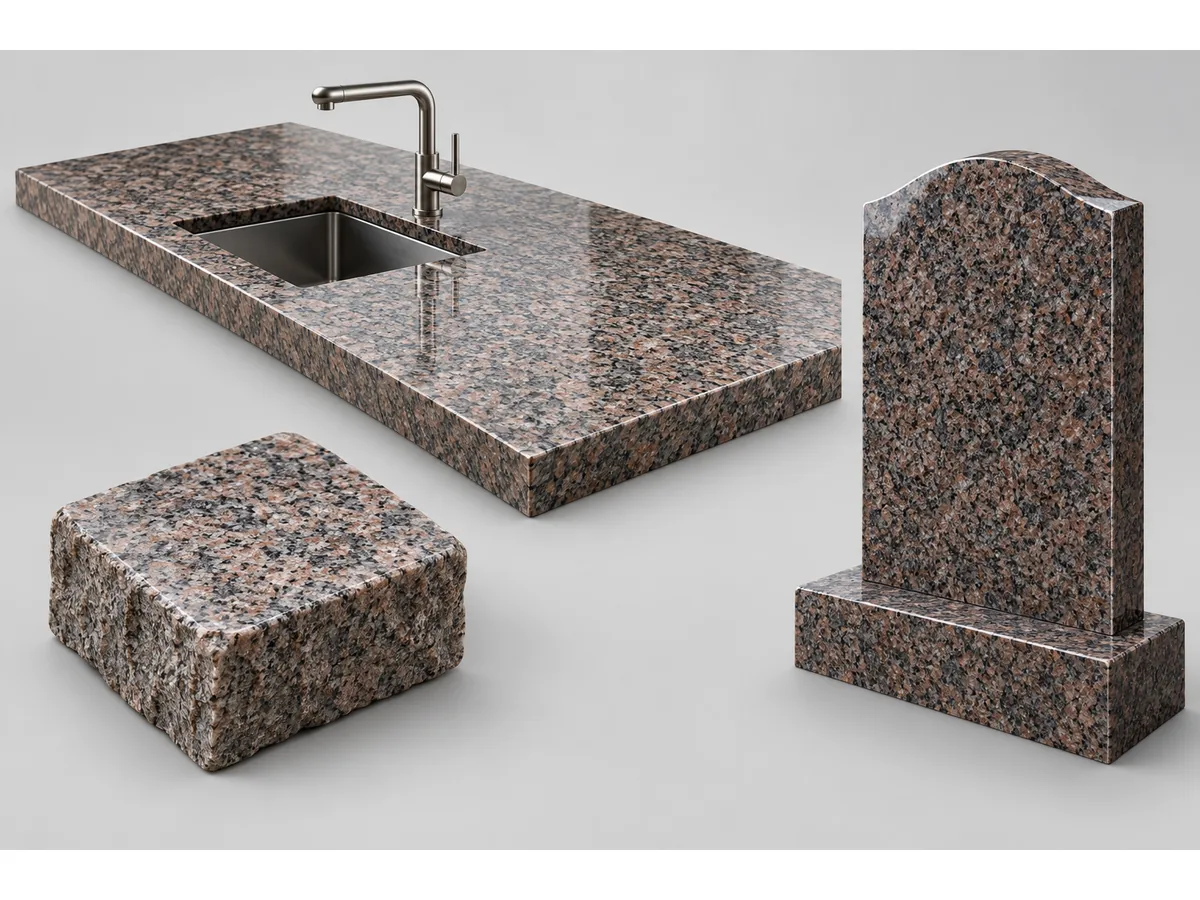
Paving: setts, paving slabs, kerbs
Driveways, paths, courtyards and pedestrian areas are the most common use. This is where paving setts and slabs come in: the stone carries traffic, frost and moisture without losing its geometry. Format is matched to the expected load and the laying method.
- sawn, split, sawn-and-split and tumbled setts;
- paving slabs for flat areas;
- granite kerbs to edge paths and driveways.
Architecture and landscape
Entrance groups, steps and gardens are where stone shapes the character of a plot. Stairs and railings must take load, while fountains and basins face constant contact with water, so the finish follows the application: polished for a gloss, honed for a matte look, thermal for the grip needed at entrances and on steps.
- entrance groups, stairs and flights of steps;
- columns, balusters, stone fences;
- fountains and basins, spheres, barbecue units.
See the architecture and landscape section.
Interiors: worktops, sills, baths
Indoors, granite is chosen for strength and appearance: the surface resists moisture, heat and everyday wear, and cleans easily. Calmer stone types suit living areas, while bolder ones work well for bar counters.
We make worktops, window sills, baths, bar counters, tables and panels to standard or custom sizes.
Cladding: slabs, blocks, wall panels
Cladding panels, slabs and blocks are used for facades, plinths and interior walls. The Rock finish is chosen where a pronounced relief surface is wanted. Stone colour and grain read differently in sunlight and indoors, so a sample is best viewed under real lighting.
Catalogue: slabs, panels and blocks.
Memorial products
In memorial work granite is valued for durability: it does not fade and is not broken down by frost and rain. It is used for single pieces as well as complete complexes, with the stone type chosen by colour and finish.
The memorial products section covers monuments, headstones, memorial complexes, flower beds, vases, bases and railings.
Stone types and ordering
We work with Pokostovsky, Leznykivsky, Didkovychsky and Maslavsky granite, Holovynsky labradorite and Bukynske gabbro; other stone types are available to order. Material details are in the granite section.
An order starts with a specification: send the list of products, stone type, format and finish. We confirm that the pieces can be made and prepare a quotation — price, format and packaging are agreed before production begins. Browse the catalogue and indicative minimum prices, then send your request through the enquiry form.
Frequently asked questions
Where is granite most often used?
Granite is most often used outdoors for paving — setts, paving slabs and kerbs. The stone carries traffic, frost and moisture without losing its geometry, so it is laid in driveways, paths, courtyards and pedestrian areas, with the format matched to the expected load and laying method.
Can granite be used indoors?
Yes, indoors granite is used for worktops, window sills, baths, bar counters, tables and panels. The surface resists moisture, heat and everyday wear and cleans easily, and pieces are made to standard or custom sizes.
Which granite finish should I choose?
The finish is chosen to suit the application. Polished granite gives a gloss, honed a calm matte look and thermal the grip needed at entrances and on steps, while the Rock finish is used where a pronounced relief surface is wanted.
How do I order granite products?
An order starts with a specification: send the list of products, the stone type, format and finish. The works confirm that the pieces can be made and prepare a quotation, and the format and packaging are agreed before production begins.